
A breaker that trips once is doing its job. A breaker that keeps tripping, possibly the same one, over and over and over, is telling you something is wrong. For homeowners in Oshawa and across Durham Region, a repeatedly tripping circuit breaker is one of the most common electrical complaints we hear, and it almost always has a fixable cause.
This guide walks you through the six most likely reasons your breaker won’t stay on and should help homeowners understand when the problem points to something more serious and call a licensed electrician in Oshawa.
What Does It Mean When a Breaker Trips?
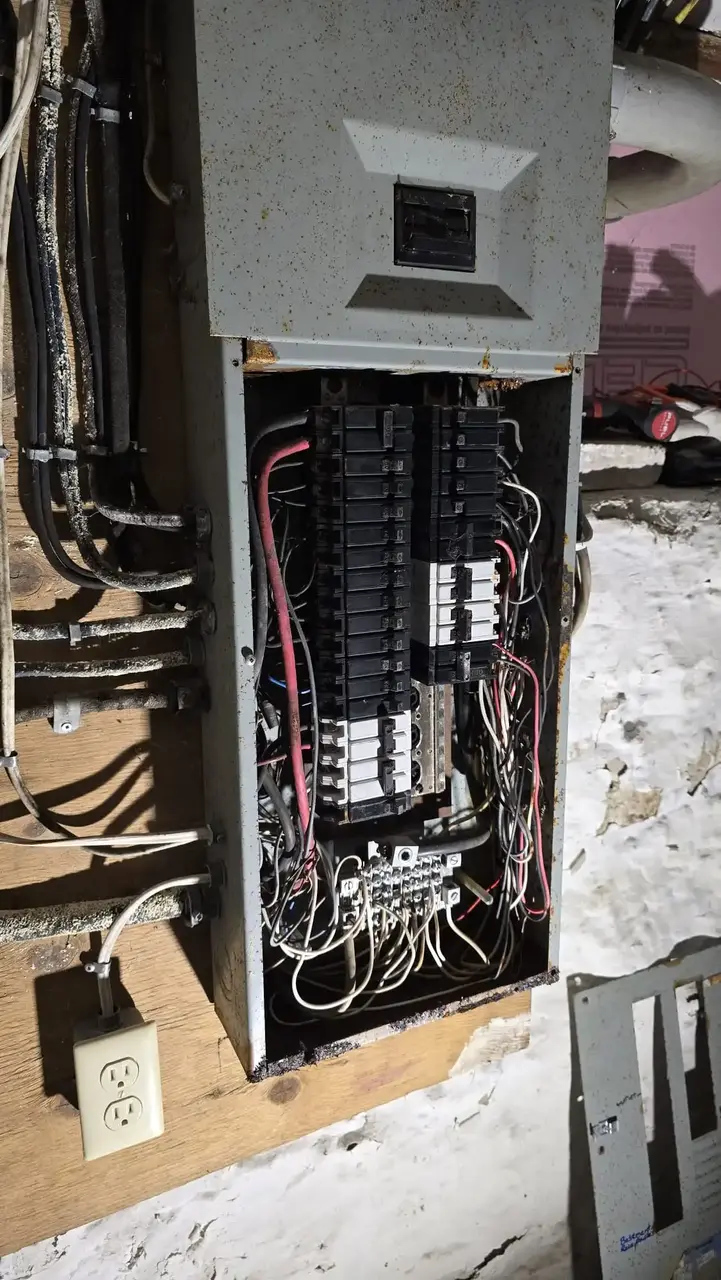
Your electrical panel contains circuit breakers, one for each circuit in your home. Each breaker is designed to cut power automatically when it detects more current than the circuit is rated to handle. This is a safety feature, not a flaw. It prevents wires from overheating and causing a fire.
When a breaker trips, you lose power to everything on that circuit, and any device plugged into an outlet and/or your lights too. You reset it by flipping it fully off, then back on. If it holds, the issue was likely a one-time overload, if it trips again, something on that circuit is drawing more power than it should, or there’s an underlying wiring or panel issue that needs attention. This is especially an urgent matter if it is within minutes, or repeatedly over days.
1. Overloaded Circuit
The most common cause. This happens when too many devices are drawing power from one circuit at the same time. Running a microwave, coffee maker, and toaster on the same kitchen circuit, for example, can easily exceed the circuit’s rated capacity, typically 15 or 20 amps.
The fix is straightforward: redistribute your devices across multiple circuits or outlets on different circuits. If your home doesn’t have enough circuits to support your appliance load, a panel upgrade or new circuit installation may be the right solution.
2. Short Circuit
A short circuit is more serious than an overload. It occurs when a hot wire touches a neutral wire. This can be either inside an appliance, inside a wall, or at an outlet or switch. The result is an immediate, high-current surge that trips the breaker instantly.
Signs of a short circuit include a burning smell, scorch marks on an outlet or plug, or a breaker that trips the moment you reset it. Short circuits require a licensed electrician… this is not a DIY repair.
3. Ground Fault
A ground fault is similar to a short circuit but involves a hot wire making contact with a ground wire or a grounded surface (like a metal outlet box or a wet surface). Ground faults are especially common in bathrooms, kitchens, garages, and outdoor circuits.
If your home has GFCI outlets (the ones with TEST/RESET button, typically found between or above the holes for the device plugs), a ground fault in that area will trip the GFCI rather than the panel breaker. If it’s tripping the breaker, it’s worth having the circuit inspected.
4. An Aging or Undersized Electrical Panel
Many Oshawa homes, particularly those built before the 1990s, were wired with 100-amp service. That was sufficient when homes had fewer high-draw appliances. Today, between HVAC systems, dishwashers, EV chargers, and smart home devices, a 100-amp panel can be chronically overloaded.
If your breaker trips regularly across multiple circuits, or if you notice the panel feels warm, makes buzzing sounds, or the breakers are old and worn, a panel upgrade is likely the right call. Upgrading from 100-amp to 200-amp service is one of the most impactful electrical improvements an Oshawa homeowner can make.
5. New High-Draw Appliances: EV Chargers, Hot Tubs, and More
Adding a high-draw appliance to an existing circuit that wasn’t designed for it is a very common cause of tripping breakers. Level 2 EV charger installation requires a dedicated 240V circuit, something many homeowners don’t realize until their panel starts acting up. The same applies to hot tubs and spa wiring, which require a dedicated circuit with appropriate amperage and GFCI protection.
If you’ve recently added one of these appliances and your breakers started tripping shortly after, the two are almost certainly related.
6. Loose or Damaged Wiring
Loose connections, deteriorated wire insulation, or corroded terminals can cause intermittent faults that trip a breaker unpredictably. This is more common in older homes, homes that have had DIY electrical work done, or properties that have experienced water damage.
Loose wiring is also a fire risk. If you suspect this is the cause, especially if breakers trip for no obvious reason and you notice flickering lights or warm outlets don’t delay getting it looked at.
When a Tripping Breaker Means You Need a Panel Upgrade
Not every tripping breaker requires a panel upgrade, but several patterns suggest it’s the underlying issue:
- Multiple different breakers trip regularly, not just one circuit
- You’ve had to add power bars and extension cords throughout the home to manage outlet demand
- The panel is original to the house and more than 25–30 years old
- You’re planning to add an EV charger, hot tub, addition, or other significant new load
- Breakers trip when you run normal combinations of appliances (oven + microwave, washer + dryer, etc.)
Leslie & Palmer Electrical provides panel upgrades throughout Durham Region and Oshawa. If you’re not sure whether your panel is the issue, an electrical inspection is the right first step, and we offer free estimates.
A Note on Older Homes in Oshawa
Oshawa has a large stock of older housing, with many homes built in the 1960s, 70s, and 80s. These properties often have electrical systems that haven’t been updated to keep up with modern demand. Some still have aluminum wiring, Federal Pacific or Zinsco panels (both known for reliability issues), or 60-amp service designed for a very different era.
If you’ve bought an older home in Oshawa or haven’t had the electrical system looked at in years, an electrical inspection will give you a clear picture of what you’re working with and flag anything that needs attention before it becomes an emergency.
What To Do When Your Breaker Trips
Follow these steps before calling an electrician:
- Turn off or unplug devices on the affected circuit, especially high-draw appliances.
- Locate your electrical panel (usually in a basement, utility room, or garage).
- Find the tripped breaker, it will be in the middle position, or flipped opposite the others.
- Push it firmly to OFF, then back to ON.
- Gradually reconnect devices one at a time to identify which one is triggering the overload.
If the breaker trips again immediately upon reset, or trips again within a few minutes even without adding load back, stop resetting it. Repeated resets on a fault condition can cause damage and create a hazard. This is when you call a professional.
When To Call an Electrician in Oshawa
Call a licensed electrician if any of the following apply:
- The breaker trips immediately on reset, or won’t stay on
- You smell burning near the panel, an outlet, or anywhere on the affected circuit
- There are scorch marks on outlets, switches, or the panel
- The breaker feels hot to the touch
- Lights flicker before or after the breaker trips
- The tripping started after adding a new appliance or having electrical work done
- The same breaker has tripped more than twice in a week with no obvious cause
For urgent electrical issues, Leslie & Palmer offers emergency electrical repair across Durham Region. For non-urgent diagnostics and panel work, we’re available for free estimates and fast scheduling.
Leslie & Palmer Electrical is a family-owned, ESA-certified electrical contractor serving Oshawa and all of Durham Region and Clarington. We offer free estimates on all electrical work; from panel upgrades to emergency repairs. Contact us today through email, text message or call (647) 271-2235.
Contact US
Whenever you need electrician, we’re here for you.
Get in touch
Serving Oshawa and Surrounding Areas.
Phone : +1 (647) 271 2235
Monday - Saturday 09:00 - 17:00
